Austin Wright
Policy Analyst, National Nuclear Security Administration
Informality, Emerging Security Domains, and the Exploration of Shared Interests

This brief is part of a series by New America’s Nuclear Futures Working Group, which brings together emerging researchers from academic, government, advocacy, and policy spaces to develop research on nuclear security policy problems through the lens of a changing global environment.
Nuclear arms control has always been a bilateral affair. Nuclear policies adopted by the Soviet Union and the United States drove a significant increase in nuclear weapon stockpiles and a diversification of capabilities. Shared security interests and the ability to make mutually beneficial concessions formed the basis of nuclear arms control. Recently, China’s divergent security interests and lack of shared capabilities with either party have called into question the utility of traditional frameworks. Combined with a degrading security environment and emerging security fields, such as space, cyber, and artificial intelligence (AI), it is clear the future of arms control will not only be an uphill battle but also wholly distinct from the past. Near-term objectives should focus on confidence building and delineating rules of engagement in regional and global contexts. Long-term objectives will require significant concessions from all parties and must be reinforced by robust monitoring, detection, and verification (MDV) capabilities.
Policy Recommendations
For all its short history, nuclear arms control has been a bilateral affair between two great powers with global ambitions. Amid exorbitant defense budgets and ballooning stockpiles, arms control was meant to ensure stability and increase the predictability of actions. The United States and the Soviet Union partnered in arms control as equals, discovering what trade-offs could be made without sacrificing an effective, credible deterrent. This arrangement is now being challenged by China’s rise as a nuclear power.
The Trump administration was adamant about containing China’s military aspirations, even going so far as to condition the extension of the New Strategic Arms Reduction (START) on Beijing’s participation. While many believe this reflected President Trump’s outspoken opposition to international collaboration, members of the Biden administration have expressed a similar interest. Despite bipartisan curiosity, New START was extended without Chinese participation. Since then, the prospect of arms control with Russia or China has diminished.
If China’s growing nuclear arsenal poses the threat American security experts believe it does, it is time to consider alternatives to traditional arms control. Leveraging informality, exploring common ground created by emerging security domains, and strategically investing in MDV technologies will form the basis of arms control efforts in the near term.
Numerous factors shape successful arms control negotiations including nuclear strategy, operational requirements, and stockpile composition, individually as well as collectively, influence the arms control space.
Nuclear strategy has the dual role of signaling the value of arms control and establishing the objectives the nuclear stockpile must achieve. Even at a time when Russia is assaulting Ukraine and military leaders are signaling China will soon invade Taiwan, President Biden has made arms control and nuclear risk reduction efforts a priority. This is reflected in the 2022 Nuclear Posture Review and is further supported by the offer to hold talks with both Russia and China without preconditions. Such initiatives exemplify the impact that leadership and a selected strategy can have on exploring arms control.
Conversely, nuclear strategy solidifies military and political parameters that shape the capabilities and size of the stockpile. The adoption of Mutually Assured Destruction (MAD) during the Cold War explains why Russia and the United States possess 90 precent of the world’s nuclear weapons today. MAD drove increases in numbers and weapon types, allowing both states to operationalize their nuclear arsenals abroad. Russia’s “escalate to de-escalate” strategy and the U.S. policy of “strategic ambiguity” and extended deterrence are used to influence international affairs, albeit in distinct ways. By intermingling foreign affairs with nuclear weapons, the two have reinforced the need to maintain larger, diverse stockpiles. These assorted stockpiles had the benefit of increasing the potential to find common ground. China, however, was not concerned with overmatch when it crossed the nuclear threshold. Adopting a minimal credible deterrence policy combined with no first use drove the development of a lean nuclear arsenal. This barebones approach came at the cost of negotiation flexibility, as the limited number of weapons and capabilities reduces the likelihood of finding common ground with third parties.
China’s growing nuclear capabilities have caused policymakers to ignore this historical divergence and the factors that presupposed the failure of expanding New START:
Any future, formalized arms control initiative will require negotiators to avoid these pitfalls.
Emerging security challenges will define future cooperative engagements. Emerging security issues, while undoubtedly complicating escalation and deterrence paradigms, will create space for negotiation. However, before we can reasonably begin to unravel the various combinations that could bring all three parties to the table, we must find ways to repair the tattered relationship and build consensus.
The establishment of these norms, information garnered from working together on these issues, and the relationships fostered during such discussions can serve the dual purpose of making us safer today while also setting the stage for future agreements.
A solidified trilateral agreement is unlikely given stockpile discrepancies and the current security climate. Therefore, the United States should seek to leverage the work discussed in the previous sections to develop tailored bilateral agreements in the event trilateral negotiations do not materialize. This arrangement should both seek to revitalize old frameworks based on shared security interests and expand the topics of conversation beyond strategic arms to discover new negotiation trade space.
Progress has flattened despite the shared arms control history between the United States and Russia. Every nuclear treaty negotiated between the two has been dismantled despite being based on shared security interests and common ground. This means the future will likely demand, on the one hand, the development of new mechanisms that can resurrect previously functioning shared security frameworks and, on the other, a serious conversation about new security frontiers previously excluded from nuclear arms control discussions.
Broader conversations in these areas are necessary. The lack of cooperation today mandates a comprehensive review of new and old systems, positions, and interests. Resuscitating the cooperative areas developed during the Cold War and introducing new security fields to the discussions is the right mix of old and new that can begin to thaw the current U.S.-Russian relationship.
Future U.S.-China cooperation is murky given discrepancies in nuclear capabilities, North Korea, and the security environment in the Pacific. China has consistently shunned olive branches from Washington and is currently expanding its nuclear capabilities. Negotiations are dependent on whether such actions are reflective of a true belief in the security environment’s degradation or rooted in Western animosity derived from the Century of Humiliation. If the latter holds, and China believes it must expand its nuclear capabilities to gain the level of respect it believes was historically withheld by the Western powers, then it is unclear what inducements may generate concessions. In the interim, there remain several areas of potential cooperation.
The era of arms control siloed to the realm of strategic offensive weaponry is ending, and emerging deterrence domains have created new avenues for nuclear escalation that are not understood. With more negotiating parties and the increasing number of fields that intersect nuclear deterrence, agreements are more likely to include items such as cyber, space, advanced conventional capabilities, and AI. These agreements are inherently going to be more complex and will require support from a robust set of MDV capabilities to ensure compliance. The table below identifies some of the areas the United States should strategically invest in to facilitate future arms control agreements.
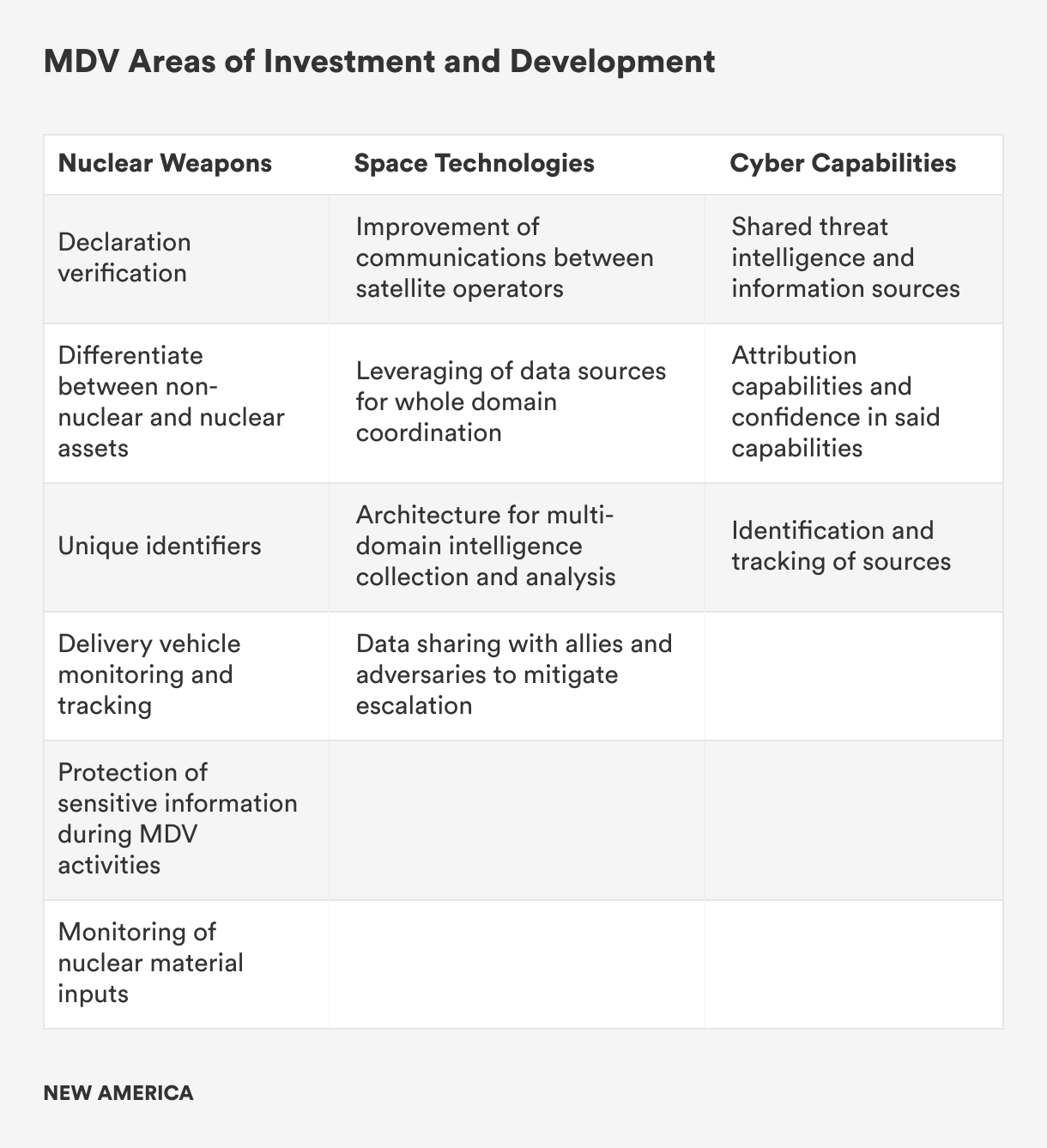
Future agreements in an era of three nuclear peers will push the bounds of arms control and require innovation. Innovation in science, and our thinking, are the only way to reduce nuclear risks and avoid unnecessary escalation in an era of evolving great power competition.
Policy Analyst, National Nuclear Security Administration