Karen J. Greenberg
Fellow, Future Security
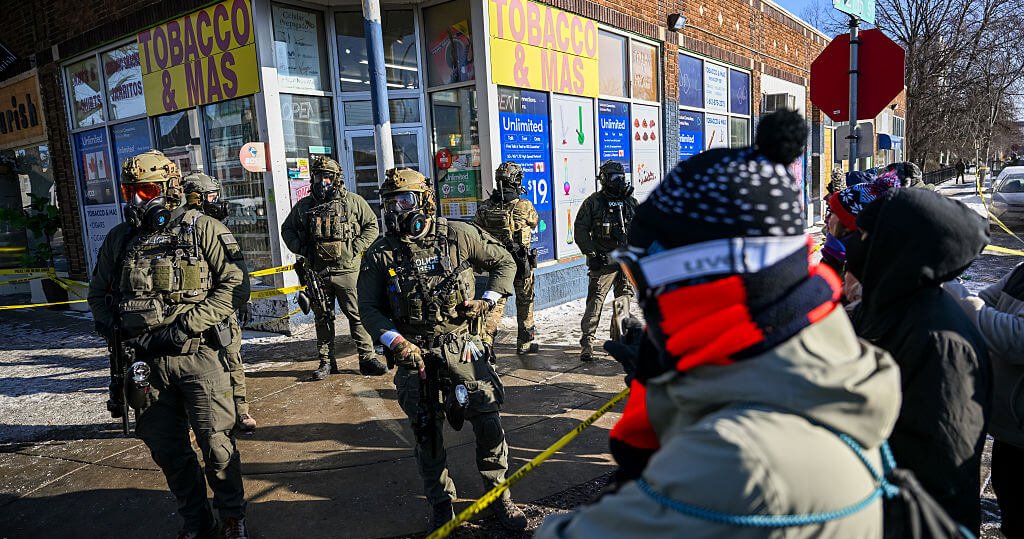
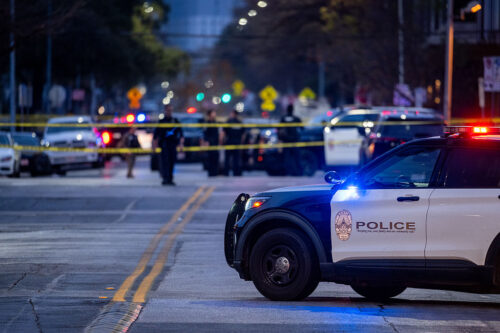
The killings of Renée Good and Alex Pretti by federal agents in Minneapolis are more than a tragedy or error by the administration. They constitute a clear signal of the trajectory of the American state. The chaos that has engulfed the streets of Minneapolis—including Immigration and Customs Enforcement (ICE) agents dragging a disabled woman out of her car, shooting a Venezuelan man in the leg, violently attacking countless civilians, raiding homes without search warrants, and harming children, even detaining a five-year old boy—is the extension of the government’s disrespect for the sanctity of values that, even in times of immense stress, have kept our democracy intact.
What we’re seeing in Minneapolis, and across the nation, are echoes of the tactics and justifications of violence that spread during the “war on terror,” honed abroad and now brought home under the banner of so-called national security. It recalls the imperial “boomerang effect” described by Hannah Arendt in The Origins of Totalitarianism, and also the grave context in which she was writing: the fascist takeover of a country, and eventually most of Europe.
In September 2025, President Trump informed 800 military leaders of the “war from within” and that U.S. city streets would serve as their training ground to combat it. Since then, Minnesotans have called ICE’s presence an “invasion.” Governor Tim Walz has declared the city a “war zone”—and in fact, Minneapolis looks like a battleground. ICE agents are behaving like untethered warriors with arms, rather than as professional, trained law enforcement agents deployed to keep the peace. And although the president has signaled standing back from his initial claims to use the Insurrection Act to deploy the 1,500 active-duty troops on standby, Governor Walz has activated the state’s national guard after recent events in Minneapolis.
What we’re seeing in Minneapolis are echoes of the tactics and justifications of violence that spread during the ‘war on terror,’ honed abroad and now brought home.
The killings of Renée Good and Alex Pretti by federal agents in Minneapolis are more than a tragedy or error by the administration. They constitute a clear signal of the trajectory of the American state. The chaos that has engulfed the streets of Minneapolis—including Immigration and Customs Enforcement (ICE) agents dragging a disabled woman out of her car, shooting a Venezuelan man in the leg, violently attacking countless civilians, raiding homes without search warrants, and harming children, even detaining a five-year old boy—is the extension of the government’s disrespect for the sanctity of values that, even in times of immense stress, have kept our democracy intact.
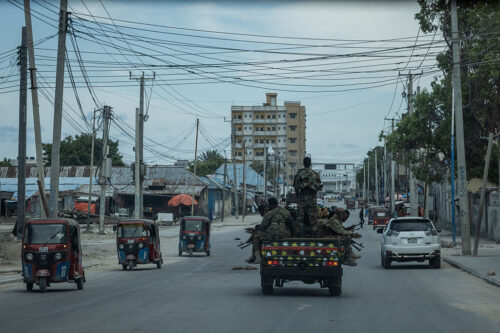
What we’re seeing in Minneapolis, and across the nation, are echoes of the tactics and justifications of violence that spread during the “war on terror,” honed abroad and now brought home under the banner of so-called national security. It recalls the imperial “boomerang effect” described by Hannah Arendt in The Origins of Totalitarianism, and also the grave context in which she was writing: the fascist takeover of a country, and eventually most of Europe.
In September 2025, President Trump informed 800 military leaders of the “war from within” and that U.S. city streets would serve as their training ground to combat it. Since then, Minnesotans have called ICE’s presence an “invasion.” Governor Tim Walz has declared the city a “war zone”—and in fact, Minneapolis looks like a battleground. ICE agents are behaving like untethered warriors with arms, rather than as professional, trained law enforcement agents deployed to keep the peace. And although the president has signaled standing back from his initial claims to use the Insurrection Act to deploy the 1,500 active-duty troops on standby, Governor Walz has activated the state’s national guard after recent events in Minneapolis.
What we’re seeing in Minneapolis are echoes of the tactics and justifications of violence that spread during the ‘war on terror,’ honed abroad and now brought home.
The very language from the war-on-terror handbook is being used by the government to justify ICE’s masked aggression. Department of Homeland Security (DHS) and ICE officials assert that the people being rounded up, attacked, and detained are “the worst of the worst,” the same words used to justify the past opening of the Guantánamo Bay detention facility and now the Alligator Alcatraz prison. Government officials refer to their victims, including Renée Good and Alex Pretti in Minneapolis, as “domestic terrorists” or “terrorists,” making the slide from the war on terror to the war on immigrants—and those who would defend them—crystal clear. This is not the first time the administration has stretched the war on terror language to justify present-day actions. The lethal attacks on Venezuelan boats, which began in September 2025 and killed at least 126 people, were done in the name of countering “narcoterrorists,” a premise that has been widely disputed.
Another pattern set in motion during the war on terror, and now echoes today, is the substitution of group guilt for evidence of individual crimes. In addition to mass surveillance and the targeting of Muslims domestically, the American government captured Muslims and individuals in Afghanistan who were in the proximity of areas they considered hotbeds of terrorism. Their names, backgrounds, and activities were often unknown at the time of capture. When the first detainees arrived at Guantánamo, the scant information their captors had was all bundled together in a single, undifferentiated mass, one person’s bit of information indistinguishable from another’s. Ethnicity, geography, and religion were grounds for detention, rather than names, facts, and individual actions.
Like the prisoners sent to Cuba, Minneapolis residents have been detained based on ethnicity, race, and broad assumptions about immigrant communities—not evidence tied to individual wrongdoings. In the language of law enforcement, ICE and Customs and Border Patrol now canvas areas rather than target individuals, operating, as journalist Garrett Graff notes, “with no idea who they might end up finding and arresting.” Add to this the targeting of American citizens who have reached out to support targets of ICE, as Pretti was doing when he reached down to help a woman who had been shoved by federal agents.
How did the cruelty of the war on terror come to reverberate through the streets of Minneapolis today? In the wake of 9/11, presidential powers were expanded to “unitary executive” levels—the theory that asserts, in essence, that the president is the executive branch. Within a week of the attacks, Congress granted the president the “authority under the Constitution to take action to deter and prevent acts of international terrorism against the United States.” This broad authorization for actions abroad did not name a specific enemy, geographical framework, or endpoint, thereby relinquishing Congressional power to declare and conduct the war at hand. In addition, agencies within the executive branch assumed broad powers to operate outside standing law, often secretly, allowing the brutality and torture of detainees to persist, including those held at CIA “black sites.”
The Justice Department followed suit, authorizing previously unlawful policies via secret memos on torture and detention. Further, courts continually dismissed and remanded cases that would challenge the executive’s authority to conduct the war on terror as it chose. As legal expert Steven Vladeck once warned in an article about court deference during the war on terror, “Dangerous precedents occur during dangerous times.” One such precedent has been the failure of the country to hold accountable those who authorized, legalized, and implemented the unlawful policies of the war on terror. This week brought echoes of such complicity when we learned about an internal DHS memo issued last May that authorizes ICE to forcefully enter homes without a search warrant as required by the Fourth Amendment.
Now in Minneapolis, we see that same determination—to not hold questionable uses of power to account—reemerge. For example, the administration has declined to investigate Jonathan Ross, the agent responsible for Good’s death. Vice President Vance initially declared that Ross has “absolute immunity,” a claim he later walked back a bit. Deputy Attorney General Todd Blanche told Fox News that “we investigate when it’s appropriate to investigate and that is not the case here.” Officials are claiming that the ICE agents have “absolute immunity.” In Stephen Miller’s words, “To all ICE officers: You have federal immunity in the conduct of your duties, and anybody who lays a hand on you or tries to stop you or tries to obstruct you is committing a felony.” As for the Pretti shooting, Secretary Kristi Noem has said DHS will be the investigating agency rather than the FBI—taking control from the agency normally authorized to investigate such incidents.
There are signs of hope, if few. The people of Minnesota are holding peaceful protests and general strikes. Mass outcry over recent events have led to Gregory Bovino being removed from his role as U.S. Border Patrol commander at large. State and local investigations are afoot into Ross’s killing of Good. Although the federal government has refused to share evidence with state authorities, those local investigations are reportedly proceeding.
Meanwhile, when a federal judge imposed restrictions on ICE detentions and the tactics used against peaceful protesters in Minneapolis, an appellate court stayed the order. And as we have seen, the administration does not seem to recognize the category of peaceful protesters as a reality.
The current chaos in Minneapolis and its attendant abandonment of regulations and law regarding the use of force, due process, and respect for the safety of city residents bring to mind the words of George Bush’s Attorney General Alberto Gonzales, who referred to international legal protections against torture as “quaint” and “obsolete.” Minneapolis is a testing ground for whether his words will prove to be victorious on the home front. Will once-sacred laws, norms, and expectations of life outside of fear prevail, or will they be buried in the name of the war on “immigrants” as they were in the “war on terror” against Muslims?
The lesson here is clear: What was once considered sacrosanct has now eroded. Its consequences are poised to spread far and wide, even beyond the original moment. Perhaps it’s time to reckon with the past and see the present as a chance to resuscitate our crumbling democracy, starting in Minneapolis.
Editor’s note: This piece has been updated to reflect that Alex Pretti was killed by federal agents belonging to Customs and Border Protection, not ICE agents.
Fellow, Future Security