Early Learning Challenge Winners Stalled in 2011 State Pre-K Funding
Blog Post
April 9, 2012
With the latest “State of Preschool” report out today, we were interested in the states highlighted in that report compared to the winners ofthe Race to the Top – Early Learning Challenge (RTT-ELC) fared. Contrary to what some might think, states that won a slice of the $500 million in federal money to improve early education systems are not the states with a record of success in state pre-kindergarten.
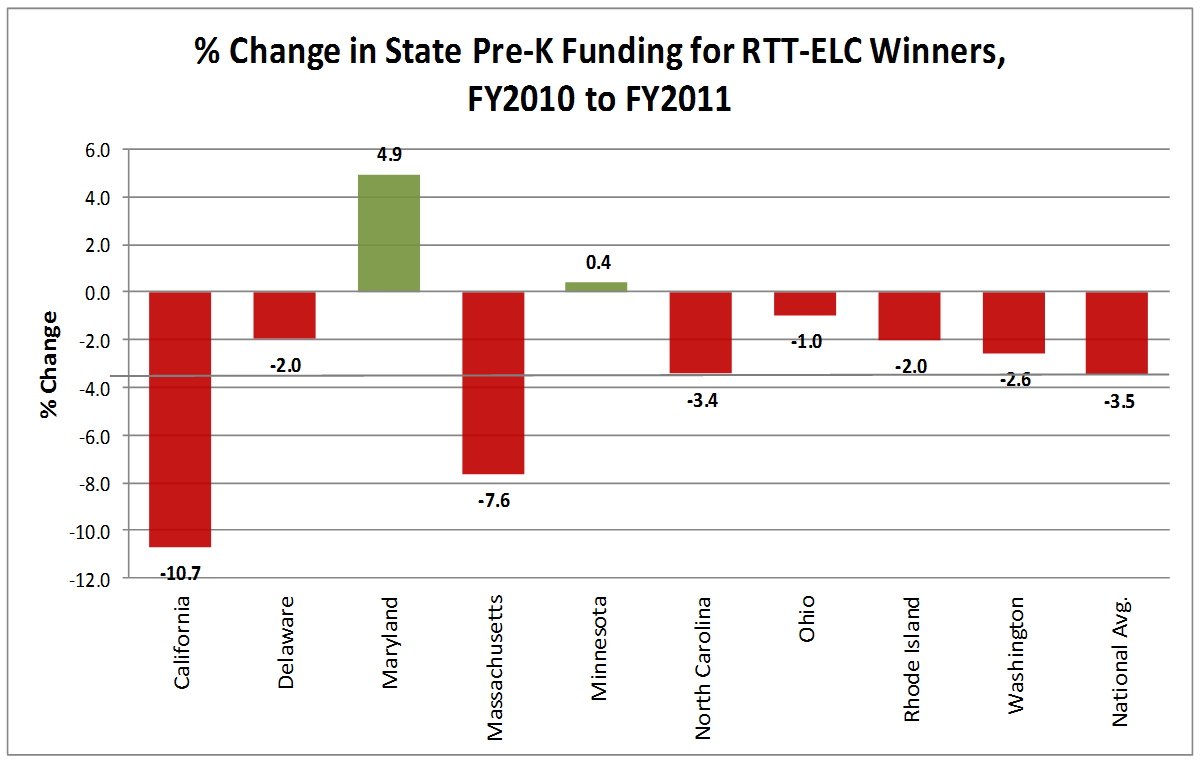
Of the nine winners of the federal competition (California, Delaware, Maryland, Massachusetts, Minnesota, North Carolina, Ohio, Rhode Island and Washington State), only two increased state spending on pre-K programs from fiscal year 2010 to 2011, according to the National Institute for Early Education Research’s (NIEER) annual report on preschool expansion . They are Maryland and Minnesota. Two other states, California and Massachusetts, cut spending in 2011 by more than 7 percent from the previous year. Maryland, which saw the biggest increase in state spending on pre-K of the nine states, grew by just under 5 percent. Nationally, average state pre-K cuts totaled slightly less than 4 percent.
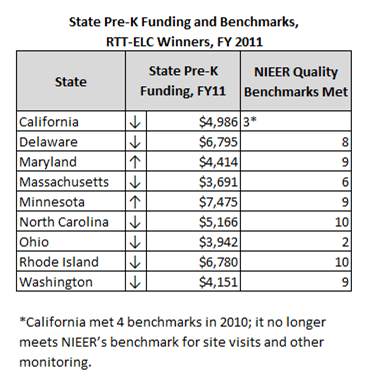
NIEER also measures the quality of state pre-K programs according to 10 benchmarks, ranging from statewide early learning standards to teacher training requirements to limitations on class size. The report found that five of the nine RTT-ELC winners met at least nine of the benchmarks. Two states – California again, as well as Ohio – met fewer than four of the benchmarks in NIEER’s latest report.
The disconnected results may be as much a reflection on the design of the Early Learning Challenge as on the priorities of the states we looked at here. Although we were surprised by some of the applicants’ RTT-ELC wins – California and North Carolina, for example – their applications scored highly enough to make up for deficiencies in their existing systems because states were judged by a combination of their records and the future plans submitted in their applications.
Early learning systems extend beyond state pre-kindergarten programs from birth (RTT-ELC applicants were required to have submitted applications to the competitive home visitation grant program created by the healthcare reform law, for example) through the early grades of elementary school. NIEER’s rankings don’t reflect states’ efforts in other early childhood arenas, such as rating systems for child care centers, which were a significant factor in the RTT-ELC competition. Nor do they include references to expanding access to full-day kindergarten and PreK-3rd alignment, which are also components of a high-quality education for young children.
Early Learning Challenge winners were announced in December, so states are starting to put their plans in action this year. We look forward to NIEER’s 2013 report for a first look at how these states have improved – or stalled – on improving access to state-funded pre-K programs with the influx of additional federal money for coordinating and building rating systems, professional development systems and other initiatives designed to give children more access to good early learning programs.