Emergent and Scripted: Debunking Either/Or False Choices about Pre-K Curricula
The challenge is designing and implementing a curriculum that balances structure with exploration, aligning adult guidance with children's natural learning processes to support meaningful application.
Blog Post
Shutterstock
Feb. 25, 2026
The National Academies of Sciences, Engineering, and Medicine released A New Vision for High-Quality Preschool Curriculum examining curriculum quality for children from ages three to five. The 13-member committee was charged with issuing recommendations aimed at creating a new vision for high quality pre-K curricula with particular attention to the needs of specific subpopulations, including Black and Latino children, multilingual learners, children with disabilities, and children experiencing poverty. The full report contains 19 conclusions reached by the committee as well as 15 recommendations.
The report notes that false dichotomies that are based on either/or thinking are common in the early education field, with the “play versus academics” dichotomy being one of the most common. New America’s Early & Elementary Education Policy program is publishing several blog posts to debunk either/or thinking and empower educators and policymakers to advocate for and implement effective pre-K curricula. This post takes on the following false dichotomies: emergent or highly scripted, spontaneous or deliberate, and exploratory or content-focused. You can also read other posts in the series: learn more about play and academics as well as social-emotional and cognitive learning.
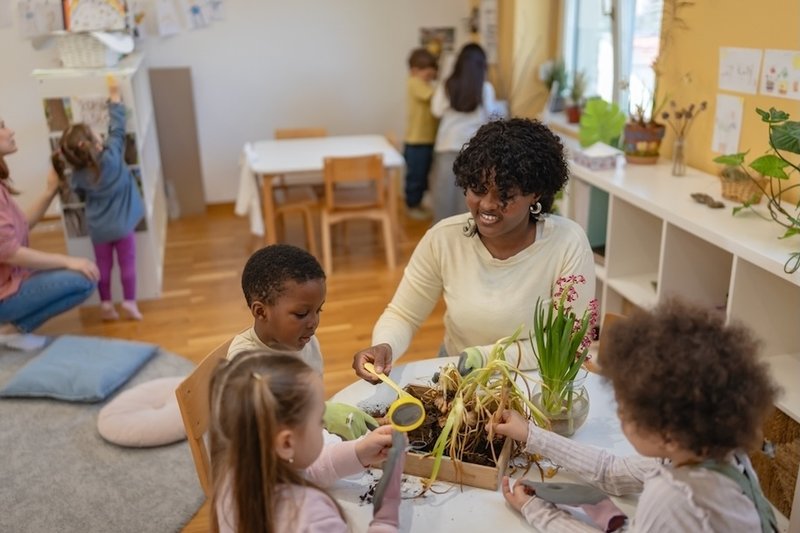
Early childhood classrooms are lively spaces where children can create, sing, dance, read, talk, and play. From an adult perspective, the question arises—how do we know they are learning what they need to know? Does this active exploration and play prepare them for school? Where is there time for academics and mastery of standards? Early childhood educators understand that children are naturally curious, making discoveries that shape their understanding of the world. They are indeed getting “ready” for school by developing critical thinking, questioning, investigatory, and social negotiation skills while also learning early literacy and numeracy skills. The challenge is designing and implementing a curriculum that balances structure with exploration, aligning adult guidance with children's natural learning processes to support meaningful application.
In a preschool classroom, during center time, the buzz of learning is palpable. At the art center, children are painting self-portraits and mixing hues of brown paint to match their skin tones while their classmates hold up mirrors and discuss how they will represent their faces at the easel. A teacher examines the concoctions and asks, “How did you mix this color?” A sand box has been converted into a water station with measuring cups, sea creatures, and floating letters and numbers. Children are busy using the measuring cups and counting aloud to fill a larger container. The teacher remarks, “Wow that container is full! Can you show me how you made it full? Let’s do it together.” Nearby, a table has playdough with tools and natural items like leaves and acorns. One child is pushing leaves into the playdough, and another takes the dough and places it on the ground to step on it, examining the imprint of her shoe. The teacher asks, “How did you make that imprint? Where did that shape come from?”
In the maker center, children are surrounded by recycled cardboard and fasteners and children are using pencils to make holes. The teacher poses a prompt, “I wonder if there are any tools to help you make a hole?” In response, one of the children holds up the hole punch. In the dramatic play area, children wear costumes and act out a story with a play microphone. The teacher joins their play and is assigned a role. She shapes herself into the role of the boat and waits for her action in the story.
In this scenario, learning is happening. Children are working as scientists to mix colors, practicing one to one correspondence with cups of water, using their imaginations to create and invent. Children are not working alone, however. The teachers play an important role in wondering aloud, asking open ended questions, offering novel materials, asking children to explain a process, or joining in their play. Learning is centered on the child’s needs and cues, as the adults have prepared to respond to children’s curiosity and wonder. Materials have been carefully selected to support and extend ideas. Teachers could not ensure children are learning unless they were aware of and planning for quality interactions.
In early childhood teaching and learning, a common false dichotomy is emergent vs. scripted which assumes pedagogical approaches that prioritize student needs and inquiry cannot coexist with standards-based instruction. The perception is that it is impossible to follow children’s curiosities and adhere to scripted curriculum at the same time. This false dichotomy does not consider that it is possible to introduce content while being responsive to children’s inquiry. In emergent curriculum, teachers observe children’s wonderings and develop curriculum stemming from their curiosity. Skilled educators can weave in standards by creatively planning provocations for learning, curating varied materials, and planning the questions they might ask to explore a concept. A teacher may say and define a key vocabulary word in conversation or place letters at the water station to encourage children to spell their names. A child signing their self-portrait and working with the teacher to sound out letters is still developing letter-sound recognition, but it is in the context of invested learning, student agency, and personal connection.
The false dichotomy of spontaneous vs. deliberate is relevant here. Exploratory learning environments incorporate deliberate scaffolding and carefully curated materials to guide learning. At the same time, the teacher can pose a spontaneous question about tools, a scaffold to help children navigate their problem.
Another false dichotomy, exploratory vs. content-focused, assumes that learning must be either student-driven or administered by adults, but effective early childhood educators know to blend both approaches. Opportunities to explore, discover, and co-construct understanding offer real-world application to learning while recognizing students need to know certain concepts and skills. There is an assumption that exploring and learning content do not go together, however students need foundational knowledge to engage meaningfully in projects. The child who is painting a self-portrait understands that the mirror is a reflection of her image, that her skin color is a nuanced shade of brown, that she is painting a self-portrait, and that she is experimenting purposefully to achieve her goal. Perhaps her teacher read a book about skin color, or the class studied an artist who painted self-portraits or used a similar technique of painting with mirrors. Her foundational knowledge makes the exploration more meaningful and gives greater purpose to her learning and understanding of the world.
The NASEM report is clear that the harm in false dichotomies is that we need to recognize children’s learning is not an either/or proposition, but rather an opportunity for a blended, balanced approach to curriculum design. Instead of treating spontaneity and deliberation as opposing forces, educators can design learning experiences that integrate intentional skill development with opportunities for organic discovery and flexibility. Teachers can develop skill-based lessons that respond to children’s curiosity and wonder. It may align with a scripted curriculum’s intentions, but it goes beyond that to authentically engage children in real-world contexts. Implications for teacher learning are important too as teaching is an art of blending inquiry with intention, thinking both proactively and in the moment to be able to guide children’s learning and discovery. Early childhood professional development that allows teachers to both understand the standards and plan for them creatively, while recognizing teachable moments, can create engaging, exploratory, and developmentally appropriate learning experiences where children thrive.
Read more about improving pre-K assessment, data, and curriculum at our collection page.