Meeting the Moment: Why Digital Skills Matter During a Crisis
Blog Post
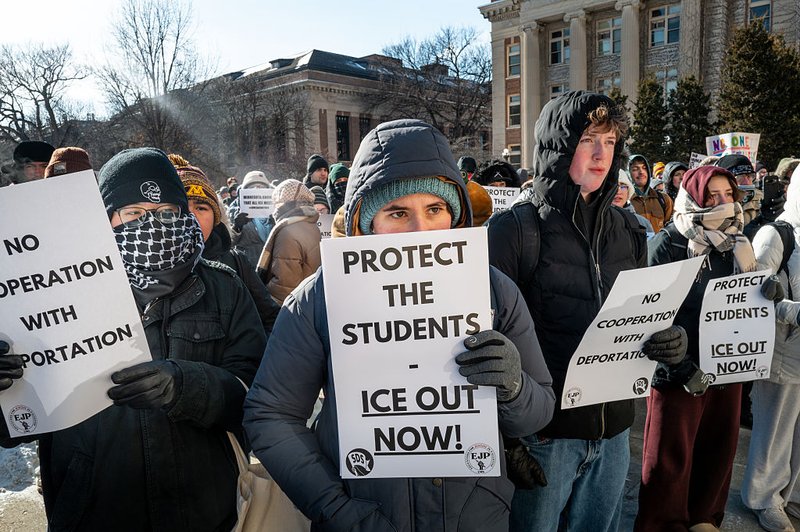
Photo by Brandon Bell/Getty Images
Feb. 27, 2026
An ongoing occupation* by federal agents is exactly the right time to talk about improving digital skills in Minnesota’s classrooms.
Since early January, our youth have watched Renee Good and Alex Pretti shot to death (from multiple angles) on social media. They saw the White House post an AI-manipulated image that depicts local civil rights attorney and activist Nekima Levy Armstrong weeping during a protest-related arrest rather than with the calm and resolve the real image shows. Online communities used artificial intelligence to falsely identify the officer who shot and killed Good; at the same time, ICE is using social media and AI to surveil immigrants and identify protesters without their knowledge or consent. Many families hiding due to fears ICE will kidnap or separate them include children once again attending school virtually with limited technology, internet access, and learning support.
These examples demonstrate that students not only need social and emotional skills but the appropriate digital skills to navigate this age of trauma. As a parent living in Minneapolis, what is happening both breaks my heart and drives me to act.
It isn’t a new conversation here, but it has become increasingly urgent. Over the past six years, young Minnesotans have experienced a pandemic, an uprising for racial justice, school shootings, a political assassination, and a chaotic democratic backslide playing out across their lives. Whether we like it or not, those experiences are now among the lenses through which they see the world and make digital choices. Local policymakers, administrators, and educators now contend with that reality as they decide exactly how to foster digital skills amid overlapping crises.
There’s no playbook here, and the research brief “Digital Literacy in the Age of AI: Analysis and Voices from the Field” makes an astute observation: The United States has never had “a comprehensive national digital literacy skills framework with measurable outcomes, and aligned systems and policies that integrate digital literacy, AI literacy, and CS.” States like Minnesota can’t wait for Washington to establish one. In a policy environment where the federal government is seeking to drastically minimize its role in public education, clear and consistent statewide leadership on this issue and competent implementation are increasingly urgent.
Recent conversations with Minnesota students, parents, educators, administrators, and policymakers (against the backdrop of Operation Metro Surge) confirmed that leadership and implementation were among our most persistent challenges even before this latest crisis. Many wonder how likely it is to make progress on these issues as the state begins to consider what healing and repair look like.
Digital Skilling Efforts in Minnesota
Minnesota as a state has for several years ranked near the very bottom nationally when it comes to computer science (CS) access and participation. Modest attempts to change this ranking have been made in earnest, but structural problems exist. Minnesota has no standalone CS curriculum standards or graduation requirements. Instead, CS standards must be embedded in other content area standards as they come up for revision every 10 years. “It got better with time,” observed one person involved in these revision processes. Arts education standards were an early but rocky test, and the social studies curriculum revisions yielded few specific references to digital skills (e.g., social media is mentioned only once). By the time science and math standards were revised, participants with knowledge about CS content were more deeply involved and able to apply Computer Science Teachers Association standards.
Despite improvements, this approach is inherently slow and tying CS skills directly to digital literacy and AI literacy remains elusive. The state’s 2020 English Language Arts standards make many references to digital literacy skills but offer only asterisks denoting when a specific standard might align to CS skills. As another example, Minnesota’s 2024 Computer Science State Strategic Plan never mentions digital literacy and refers only once to artificial intelligence as a category of CS. Each concept has its own unique origins and proponents, creating competition between factions that complicates the work to integrate all three in a holistic fashion.
Facilitating across the various factions and supporting districts and schools to implement cross-disciplinary edtech strategies would be a natural role for our state edtech office, similar to the U.S. Department of Education’s Office of Educational Technology. Minnesota has not had this agency function in recent history, though a 2016 report commissioned by the state legislature made the formation of such an office a central recommendation. As the brief’s authors point out, a lack of state leadership and clear direction leaves classroom practitioners “unsure how to connect existing efforts with new opportunities, how to prepare, what to prioritize, or how to scaffold to best meet the needs of their students.”
Despite state leadership and implementation gaps, local leaders are modeling a more holistic approach to digital skilling. St. Cloud Area School District’s Superintendent Lori Putnam has been a vocal champion for this approach, investing resources into professional learning and convening state and national stakeholders to move “beyond visionary conversations into hands-on learning and collaborative action.” Donna Roper, St. Cloud’s Director of Research, Assessment, and Generative AI Integration, leads this work and emphasized that adopting technology is a “high-impact change strategy” that requires systemic change.
This systems change mindset inspired the district’s “guiding principles” and their approach to professional learning. A recent leadership team meeting started by asking school leaders to consider how specific AI tools or uses might support or bypass learning goals. Roper believes clear expectations and exercises like this help school leaders improve their discernment and their ability to make more critical real-time decisions about the use of technology in their classrooms.
Sharing resources and best practices is essential when district resources are limited and questions are mounting. A desire to learn with and from peers like St. Cloud led to the formation of Minnesota Education Generative AI Alliance, a self-organized coalition committed to the ethical and effective integration of AI into education. The group maintains an evolving resource hub and regularly convenes virtual meetings to discuss use cases and collaborate on shared challenges. The meetings are energetic and engaging, and recent topics covered included a discussion about acceptable use policies, practice using AI as a thought partner, and disrupting AI misuse by students.
More formal channels exist to deepen and scale these collaborative spaces to the places where staffing or funding is limited. The Minnesota Service Cooperatives are designed to meet needs that districts aren’t able to manage themselves, and this can range from districtwide technology services to crisis response capacity to professional learning. After hearing from rural teachers hungry to learn how to integrate technology into their instruction in safe, ethical, and effective ways, the Southwest West Central Cooperative began hosting EdTech Connect, a conference to weave data literacy, digital literacy, AI literacy, and global literacy into practical classroom strategies. This philosophy and approach could serve as a model across the cooperative network.
A Statewide Focus on Digital Skills Is Increasingly Urgent
While Minnesotans can stretch a hotdish to feed 12, this isn’t a time to cut corners. A federal immigration crackdown combined with a federal funding retreat requires us to maintain a relentless, statewide focus on ensuring no learner or educator is left without the skills they need to thrive. Consequential state and federal elections are looming, and predictions abound that this will slow progress on almost every issue.
Erin Walsh, co-founder of the Spark & Stitch Institute and a local public school parent, believes that the ICE occupation “revealed the degree to which the ‘digital divide’ still persists in our communities,” and she warns that failing to include digital skills in our recovery will leave more students behind.
Digital literacy will help a Worthington high schooler question content demonizing immigrants the next time it appears in their feed. AI literacy will help a Duluth teacher use artificial intelligence to draft standards-aligned lesson plans that keep his virtual learners engaged until they are safe to return to campus. CS skills will help a Saint Paul middle schooler code digital tools to facilitate more efficient and secure mutual aid deliveries in her neighborhood.
Rather than pushing digital skills further down the list due to competing commitments, we need statewide political and policy leaders who understand that these skills are inextricably linked to our students’ current lives and future livelihoods.
*Like many fellow Minnesotans, I consider the occupation active until local ICE/CBP staffing levels return to their pre-December 2025 levels.
For further reading and discussion on digital literacy, please see this research brief "Digital Literacy in the Age of AI: Analysis and Voices from the Field."