Digging into Higher Ed Stimulus Construction Funds
Blog Post
Feb. 2, 2009
The Senate and House of Representatives versions of the stimulus legislation both contain billions of dollars for institutions of higher education to modernize, renovate, and repair their existing instructional and research facilities. But there are crucial differences between the two bills that will have important ramifications for states and institutions of higher education, especially community colleges.
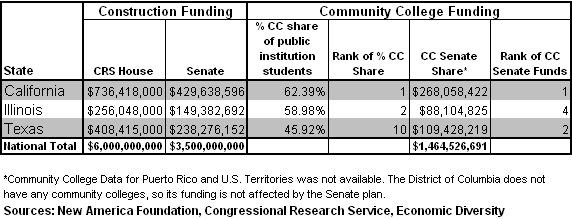
Unlike the additional Title I stimulus funding, which yielded surprising winners and losers, the higher ed construction money would be doled out relative to a state's percentage share of the total full-time equivalent national undergraduate population. (This includes students at public and private nonprofit schools, but not those at for-profit institutions like the University of Phoenix). It is unsurprising, therefore, that highly populated states (California, Texas) will receive the most money, while small population states (Alaska, Wyoming) will receive the least.
The most obvious difference between the Senate and the House bills is money. The Senate bill provides only $3.5 billion for higher ed construction, just over half of the House's $6 billion mark. That means 42 percent less funding for each state if the Senate's version wins out in conference. California would lose $306.8 million.
Community colleges, however, could potentially get more construction money under the Senate's plan. The Senate bill requires states to allocate a share of construction funding equal to the percentage of their students at public institutions that attend community colleges. This assures community colleges will at least get their fair share of funds.
Community colleges in states with large private college or university populations will make out even better. The Senate bill requires that overall higher ed construction money be allocated based on a state's total percentage share of undergraduate students, which includes private colleges. But the percentage of that money going to community colleges is allocated only looking at their share of students in public institutions-excluding the students at private, nonprofit schools. In other words, if community college students make up only 15 percent of a state's total undergraduate population, but 25 percent of the students in public institutions, they would receive one-quarter of the state's higher ed construction funds.
To give readers an estimate of how higher ed construction money would be distributed under both bills, we used House funding estimates to calculate Senate bill distributions to states and community colleges specifically.[1] According to our analysis, California's community colleges would get the most money under the Senate metric ($268.1 million) because California has the largest community college population and those students make up 62.4 percent of all students in public institutions. Illinois has the second largest percentage share of community college students at 59.0 percent, but the size of the state's overall award means community colleges would receive $88.1 million, the fourth-most under this calculation. Texas, however, is estimated to receive the second most community college funding ($109.4 million), even though its share of community college students (45.9 percent) is only 10th highest. This is because Texas has the second largest overall share of the nation's undergraduate population, giving it a bigger award to draw from.
The greater allocation in the House bill versus guaranteed community college funding in the Senate should make for an interesting debate over these funds when the bills go to the conference committee. Check back at Ed Money Watch, where we will keep digging into this issue.
A spreadsheet showing the amount of higher ed construction money the 50 states, District of Columbia, Puerto Rico, and other U.S. Territories can expect to receive under both the House and Senate plans as well as the distribution of funds to community colleges under the Senate plan can be downloaded here.
[1] The House estimate is based on calculations run by the Congressional Research Service. Using those figures, we calculated the percentage share each state would receive, which we used to calculate the estimated Senate spending figure. The estimated share of community college students was calculated using full-time equivalent undergraduate enrollment data from the fall of 2006 (the most recent data that is publicly available) from economicdiversity.org. This estimate was used to calculate the share of construction funds community colleges in each state would receive.