Wisdom of the Crowds: From Boulder to Dayton
Blog Post
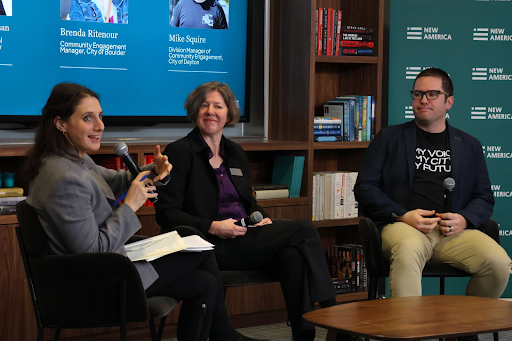
Photo courtesy of FIDE - North America.
Jan. 26, 2026
This post was co-authored by Marjan Ehsassi, Executive Director of FIDE - North America, and Cole Speidel, Program Manager at FIDE - North America.
Less than ten years ago, citizens’ assemblies were a novel concept to many local government officials in the US. Today, cities like Dayton, Ohio, and Boulder, Colorado, are championing new approaches to civic engagement through the implementation of assemblies. Citizens’ assemblies are a method of engaging everyday people in decision making through sortition, a lottery based deliberative practice. Assemblies are part of a larger movement of deliberative practices that have been growing since the 1980s and have continued to gain momentum since the 2010s, according to the OECD. To document and capture this work, New America’s Political Reform Program, FIDE - North America (Federation for Innovation in Democracy), and the National Civic League hosted a panel discussion on January 15th exploring the potential to institutionalize citizens’ assemblies in the United States. The panel served as a kick-off for FIDE - North America’s closed door convening of citizens’ assembly implementers from across the US and Canada, which took place the following day.
In the spirit of gathering and dialogue, participants from across the country came together to listen and share insights on this novel approach to civic engagement. The energy in the room was curious and eager, driven by a desire to explore new pathways to democratic participation at a moment when citizen voices feel more constrained than ever. The panel included Brenda Ritenour, Community Engagement Manager for the City of Boulder, and Mike Squire, Division Manager of Community Engagement for the City of Dayton. The discussion was moderated by Dr. Hollie Russon Gilman, Senior Fellow at New America’s Political Reform Program.
Dayton and Boulder differ starkly in their demographic makeup. Boulder’s population is 77% white and 11% Latino, with a largely affluent community—residents with money, expertise, time, and PhDs. In contrast, Dayton is an incredibly diverse city with a rich arts history. As a Rust Belt city, Dayton was deeply affected by sprawl and white flight. Once a city that experienced economic prosperity and stability, Dayton saw major employers like General Motors shut down and leave, contributing to a lasting sense of distrust in institutions among residents. In both cities, those who show up to traditional engagement events are often already the loudest voices in the room. As both panelists explained, citizens’ assemblies offer the opportunity to compensate participants, provide childcare and language access, and grant real decision-making power—eliminating key barriers to participation.
For Boulder, the decision to run an assembly was driven by a desire to elevate voices that did not traditionally participate in engagement processes. As part of the city’s comprehensive plan update, leaders saw an opportunity to prioritize equity in who they engaged, leading to the creation of the assembly. Over seven Saturdays, members of the assembly gathered to discuss the definition, essential services, and values that would shape the design of 15-minute neighborhoods in Boulder Valley. The assembly came up with 15 majority recommendations on how to implement these neighborhoods which were presented to the City Council in December of 2025. The draft plan will be released in March 2026. While Boulder collaborated with several organizations, the effort ultimately relied on the entrepreneurial spirit and resourcefulness of city staff, who pioneered the assembly initiative.
Dayton is in the early stages of planning the assembly. City leadership has been supportive of the process, though stepping into the unknown has been challenging. Initially, Dayton had a topic in mind; however, the advisory board for the assembly process recommended listening to the community before selecting a topic. While Mike noted it can be daunting to hand over the reins to community members without clear guardrails, a core part of the process is allowing the community autonomy in agenda setting.
Although these communities are in different parts of the country, the issue of financial constraints are similar. Dayton is currently facing a multi-million-dollar budget deficit and is working to piece together funding through external resources including leveraging philanthropic capital. Still, there was a shared understanding that engagement is an investment—one that pays dividends many times over. From a long-term planning perspective, early investment in community engagement helps lay the groundwork for more sustainable and effective outcomes.
While the assembly process may be novel in the United States, the core elements of engagement are not. In a world constantly competing for people’s time, attention, and resources, assemblies succeed by meeting people where they are. They also offer an opportunity for deepening connection, belonging, voice, and civic agency. This means investing in the conditions that make participation possible by building trust, creating welcoming spaces, and removing barriers through translators, childcare, and shared meals. As Brenda put it best, “sweet tea is belonging.”
You May Also Like
- Listening at Scale in California: Inside the Possibility Lab’s Collaborative Model (Hollie Russon Gilman and Sarah Jacob, 2025)
- Voice Insecurity: Mapping the Consequences of Institutional Exclusion & Charting a Path to Democratic Renewal with Citizens’ Assemblies (Atl Castro Asmussen and Marjan Ehsassi, 2025)
- The People’s Plan for Hughes (Hollie Russon Gilman and Sarah Jacob, 2025)