The Us@250 Experience: Building a New American Future
Blog Post
Annan Productions LLC
Dec. 4, 2025
“We are in a time,” New America CEO Anne-Marie Slaughter says, “when it can be hard to maintain faith in America as an ever-renewing nation.” For all those gathered at New America’s offices and streaming online, her opening remarks help frame the day, serving as a call to be honest with ourselves and the country. How can we ground our aspirations for the future in both pride and reckoning?
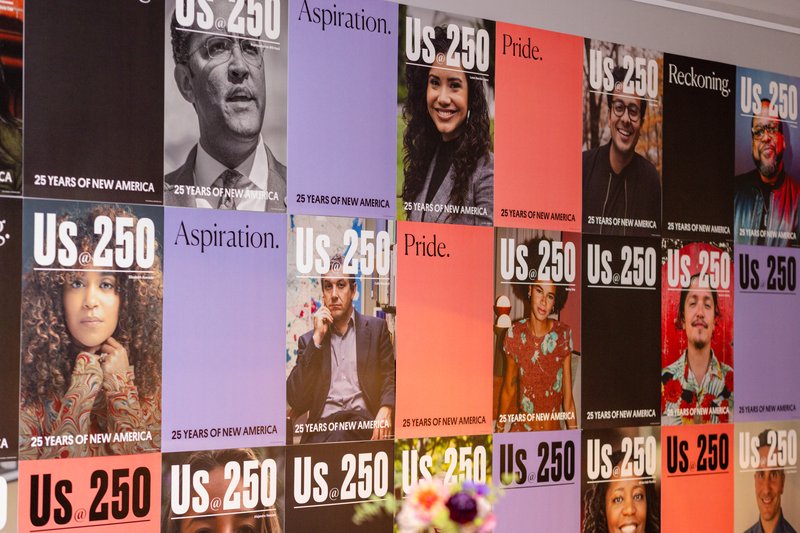
We are in the nation’s capital for the Us@250 Experience, a day-long signature event marking the nation’s upcoming semiquincentennial anniversary. The panels and performances feature a diverse array of scholars, writers, artists, policymakers, and historians, all of it meant to help us reflect on who we are as a people and where we might be going. And to undertake the hard but necessary work of building upon the victories of our better angels and learning from those times when we’ve fallen short of our founding, “self-evident” ideals.
“There is always tension in the gap between ideals and practice,” presidential historian and senior fellow Alexis Coe observes during the event’s first panel conversation, which also features a congressman, a documentary filmmaker, and the executive director of a civic-minded nonprofit. “The work of democracy is closing that gap without pretending the gap doesn't exist.”
Will Hurd, the former U.S. representative from Texas’ 23rd congressional district, declares that democracy is “rare and fragile.” He shares a moving story about carrying a little girl in Kashmir onto a Chinook helicopter following 2005’s apocalyptic earthquake. “On that day, America was the only country with the resources and will to help people 7,000 miles away.” It was “we, the people,” he says, who decided that this was work worth doing—that this represented who we were, who we can believe ourselves to be.
Notions of faith are central to American life—the religious sort, sure, but also civic and social faiths, too. We are, at least in our national mythos, an endlessly optimistic people, and optimism requires both belief in a better future (though who that future is for has been a defining question) and a willingness to strive for it. The nation’s traditional motto E pluribus unum—out of many, one—is invoked more than once today. But who is the “we,” these “many?” Are we actually “one,” and do we even want to be? Upon whom or what shall we place our faith?
“Politics makes a terrible god,” says Andrew Hanauer, a nonprofit leader who works with faith leaders from across religions to address toxic polarization. His argument is that when we organize our behaviors around political identities, we privilege conflict and rejection of others. He is joined on the second panel by author and historian Colin Woodard, who shares that the nation’s story had to be “made up ex post facto,” and we’ve been fighting over it ever since. Despite today’s political tribalism, his research finds that Americans believe in defending inalienable rights for themselves and others, but that the solidarity falls way off “once party identity is invoked.” MSNBC White House correspondent Laura Barrón-López and author/poet Elizabeth Acevedo round out the conversation, both stressing the importance of language and hyper-specific stories to making America more inclusive, more honest with itself and its people, and more instructive for posterity.
Part of the allure of political identities is that they offer belonging. Though this may address some of the loneliness that seems widespread today, it often comes at the expense of community and multiracial democracy. Elizabeth makes the case that a more constructive way to foster belonging is to share stories true to individuals’ experiences, which are “invitations” to connect person to person. Listening to another’s story is one way to demonstrate that despite differences, you matter to one another.
And really listening to another person in real and active ways is becoming more important than ever, as Marley Dias—a Gen Z civic activist and college senior—points out during her keynote before the third panel. She reminds us of the way the nation’s mythos has marginalized some of its people, and how the rapid proliferation of AI complicates which stories and videos and information we can believe.
Many of the day’s ideas encourage a reorienting of priorities. They ask us to resist the crisis of faith that Anne-Marie rightly cited, and instead, rejuvenate ourselves through local connections, communal care and affection, and the power of stories and shared experiences.
From poetry to film to music, from a thoughtfully curated lunch to comedy to good-faith discussions, the Us@250 Experience offers its namesake—an aesthetic and intellectual experience of American perspectives and reflections. At one point, Alexis sums up a central takeaway: You miss so much when you aren’t curious about others.
And we see this in a beautiful short documentary by fellow Alejandra Vasquez, “When It’s Good, It’s Good,” about her hometown of Denver City, Texas, an oilfield town in the Permian Basin where the truths of life and family resist easy political categorization. “‘American’ is a diverse identity,” she says during her remarks. The closer you look, the more complex we become. Jason Mangone of More in Common US agrees, during his remarks, detailing research that finds Americans love where they live “but are confused by their country.” Connection, he says, has to be community-focused and pre-political, because “politics is zero sum, but life is not.”
This is a truth that is easy to forget—or to willfully reject—when the allure of political identity is too great a temptation. As the writer George Packer puts it during the last conversation of the day, somewhere along the way it just became too politically and financially valuable for party elites to operate by inflaming the rest of us.
The poet and artist Adrian H. Molina, an inaugural Us@250 fellow, proclaimed during a rousing call-and-response poem that kickstarted the Us@250 Experience that “democracy is a spirit” as much as it is a set of systems.
It strikes me that the best path forward may be a sort of Pascal’s Wager, the philosophical conceit that argues belief in the divine without proof is a safer bet than a denial of it. A winning wager stands to inherit everything, in other words, at no greater price than the loss of a few temporal pleasures.
If we apply a version of this to ourselves—call it a new American Wager, perhaps—we might deny ourselves the short-term solace of political belonging that excludes others, and instead go all-in on the renewing promise of our founding principles and ourselves as a people. Stake our fortunes on the hope that we matter to one another, that what we want to be true exists within each of us. Believe that good leaders emerge from local engagement and civic participation. Count on our better angels.
If the stakes seem too high, then maybe we were never who we claimed to be. But I think that if we take the time to look and listen and be curious, we’ll find in each other all the proof we need.